

Five Vulnerable Things: Vol. 35
On timelines, the pull, glasses, bald spots, and the stories we tell ourselves.

Monsoon Season is a newsletter and podcast by meditation teacher and writer, Asa Yee. It lives at the intersection of culture, consciousness, and creativity. It is about the messy, beautiful, non-linear work of becoming. The courage to be seen. The belief that the most spiritual thing any of us can do is…be vulnerable.
One of the most fascinating things I’ve learned recently is that your brain doesn’t simply observe reality. It predicts reality.
Before your eyes fully process what you’re seeing, your brain is already making educated guesses based on memory, habit, past experience, and expectation.
Which made me wonder:
How much of our suffering is actually coming from reality?
And how much of it is coming from prediction?
Because this week, I watched my mind predict catastrophe from a dime-sized bald spot. I watched it jump between alternate timelines. I watched it mistake anxiety for intuition.
Meditation isn’t teaching us how to control our thoughts.
It’s teaching us how to notice when we’re living inside a prediction, instead of the present moment.
1. The mind loves a backup plan.
I was listening to a podcast this week when the host said one of the biggest forms of self-sabotage is living on two timelines at once.
Oof.
I’ve spent the last year building Monsoon Season. Recording the podcast. Writing every week. Showing up more consistently than I ever have before. And from the outside, I think it probably looks like I’m fully committed.
But if I’m being honest, part of me is still keeping the emergency exit unlocked.
If this doesn’t work, I can always go back to freelance copywriting.
If the podcast stalls, I can focus more on coaching.
If that doesn’t work, maybe I’ll...
You get the idea.
The funny thing is that I used to think this was wisdom. Being practical. Being prepared. Not putting all my eggs in one basket.
Now I’m not so sure.
Because what if some of our backup plans aren’t wisdom at all?
What if it’s fear?
What if the reason we can’t fully arrive in our lives is because we’re secretly rehearsing our escape route?
As a first-generation kid, contingency planning was basically a love language. Have a plan. Have a second plan. Have a third plan. Be prepared. Don’t be foolish.
And there is real wisdom in that.
But there’s also a moment where preparation becomes hesitation.
Where safety becomes a cage.
Where you become so busy keeping your options open that you never fully inhabit the option you’ve already chosen.
I don’t know the answer yet.
I just know that when I heard those words, I felt something tighten in my chest.
Maybe because a part of me already knew they were true.
Sutra: You cannot fully arrive in a life you’re constantly preparing to leave.
Reference: Motion podcast by JB Copeland | Episode: the subconscious thief that blocks your way forward.
2. Intuition feels boring.
The same podcast host shared something else that I haven’t stopped thinking about.
He described intuition as a lazy river, it pulls. And anxiety as a wave pool, it pushes.
The older I get, the more I realize how addicted I’ve become to urgency. I like feeling needed. I like momentum. Sometimes I like the rush of thinking everything matters.
I catch myself doing it all the time.
I need to reply to this email right now.
I need to make this post right now.
I need to figure this out right now.
The energy underneath it feels productive and ambitious.
But, it often feels more like panic than wisdom.
The irony is that before, my biggest challenge was showing up.
For years, I was terrified of being visible. Terrified of sharing my work. Terrified of putting my voice out into the world.
Now I have consistency and I show up.
And I’m realizing the next level isn’t discipline.
The next level is trust.
Trusting the thing that keeps quietly pulling at me, even when it isn’t exciting.
Maybe intuition feels boring because it doesn’t need to convince you. It just waits.
Sutra: Anxiety pushes. Intuition pulls.
3. You don’t see the world as it is.
This week I got my first pair of glasses prescription in 36 years of life.
During the appointment, my eye doctor explained something fascinating about vision. Your brain fills in an enormous amount of information automatically. There are gaps in what we see, and our minds are constantly completing the picture.

The mind does the exact same thing.
A friend doesn’t text back.
We fill in the blank.
A crush ghosts us.
We fill in the blank.
Someone unfollows us online.
We fill in the blank.
Most of the suffering in my life hasn’t come from what actually happened.
It’s come from the story I created to explain what happened.
How much of what you call reality is actually memory, conditioning, assumptions, fear, and habit?
We spend so much of our lives believing our thoughts.
Meditation asks a different question:
What if your thoughts are simply one perspective among many?
Sutra: Most of what we suffer from is not reality. It’s our interpretation of reality.
4. A bald spot and a thousand stories.
This past week I found a new patch of alopecia. Something I’ve struggled with for many years due to my autoimmune condition, and it’s really fucking hard to deal with.


This time it’s about the size of a dime.
The last time this happened was years ago.
And what surprised me wasn’t the fear.
It was how quickly my mind went to work.
Within seconds, I’d already built an entire narrative.
What did I do wrong?
Was I too stressed?
Did I eat something?
Is this my fault?
What if it gets worse?
What if I lose all my hair again?
The mind is incredible.
Give it a tiny piece of information and it’ll write an entire Lord of the Rings trilogy.
The next morning, I called a dermatologist. Less than twenty-four hours later, I was getting cortisone injections and beginning treatment.
And what struck me afterward was how different my actions were from my thoughts.
My thoughts were panicking.
My actions were calm.
My thoughts were catastrophizing.
My actions were practical.
My thoughts were living in the future.
My actions were rooted in the present.
We don’t control what thoughts arise. We control how we respond to them.
99% of action is taking place in our minds (invisible to others), so training our mind to respond with calmness, with a samurai-level steadiness is integral to our survival.
I think so many of us believe healing means having better thoughts.
Maybe healing is simply becoming less obedient to the ones we already have that don’t serve us anymore.
I might lose all my hair again, but it’s not up to me to stop it from happening. All I can do is respond lovingly to the circumstances, and not blame myself for being human.
Sutra: A thought is not a prophecy. It is merely a visitor.
5. Roses.
The morning after my dermatologist appointment, I sat down to meditate.
And for some reason, instead of imagining my hair growing back, I imagined roses growing from my scalp.
Rosebuds pushing through the empty space.
Blooming where I thought something had been lost.
I know that sounds ridiculous.
But it felt strangely comforting.
I’ve been reading Rumi before bed lately, and one passage was a salve for my heart.
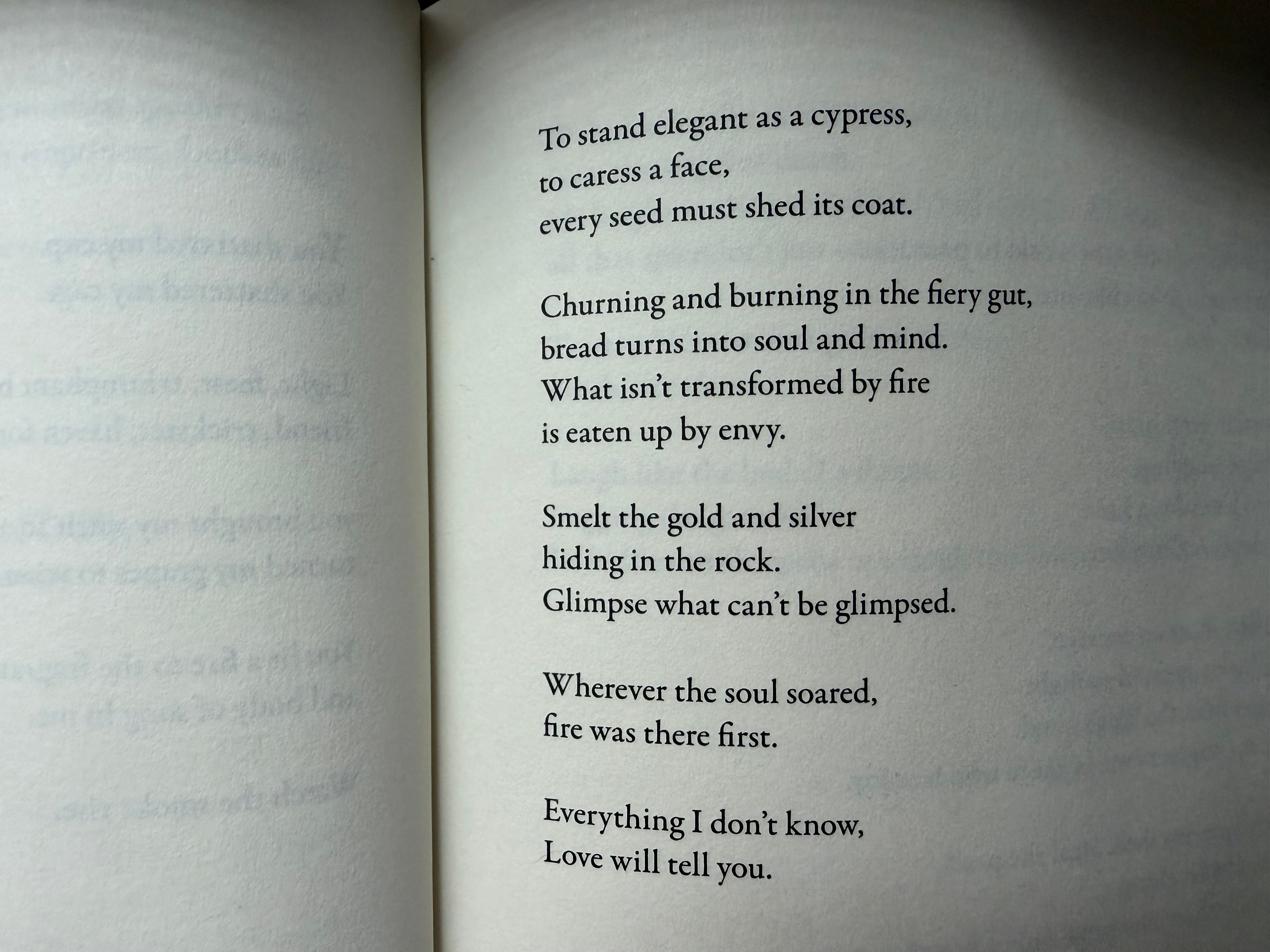
A few years ago, I would’ve read those words and thought they were beautiful.
Now I understand them differently.
Because life keeps taking things from us.
Our certainty.
Our plans.
Our identities.
Our hair.
Our youth.
Our guarantees.
And yet somehow we remain.
Something deeper remains.
Not untouched by life, but transformed by it.
The older I get, the less interested I am in controlling what happens.
The more interested I am in how I meet what happens.
Maybe that’s what meditation has been teaching me all along.
Not how to avoid suffering.
Not how to become positive.
Not how to win.
Just how to stay.
Sutra: Everything I don’t know, love will tell me.

Listen to the latest episode of Monsoon Season
Stay soft,
Asa