

Five Vulnerable Things Vol. 33
Dhurandhar: On Vigilance, Emptiness, and Becoming No One

Monsoon Season is a newsletter and podcast by meditation teacher and writer, Asa Yee. It lives at the intersection of culture, consciousness, and creativity. It is about the messy, beautiful, non-linear work of becoming. The courage to be seen. The belief that the most spiritual thing any of us can do is be vulnerable.
Hey soul friends!
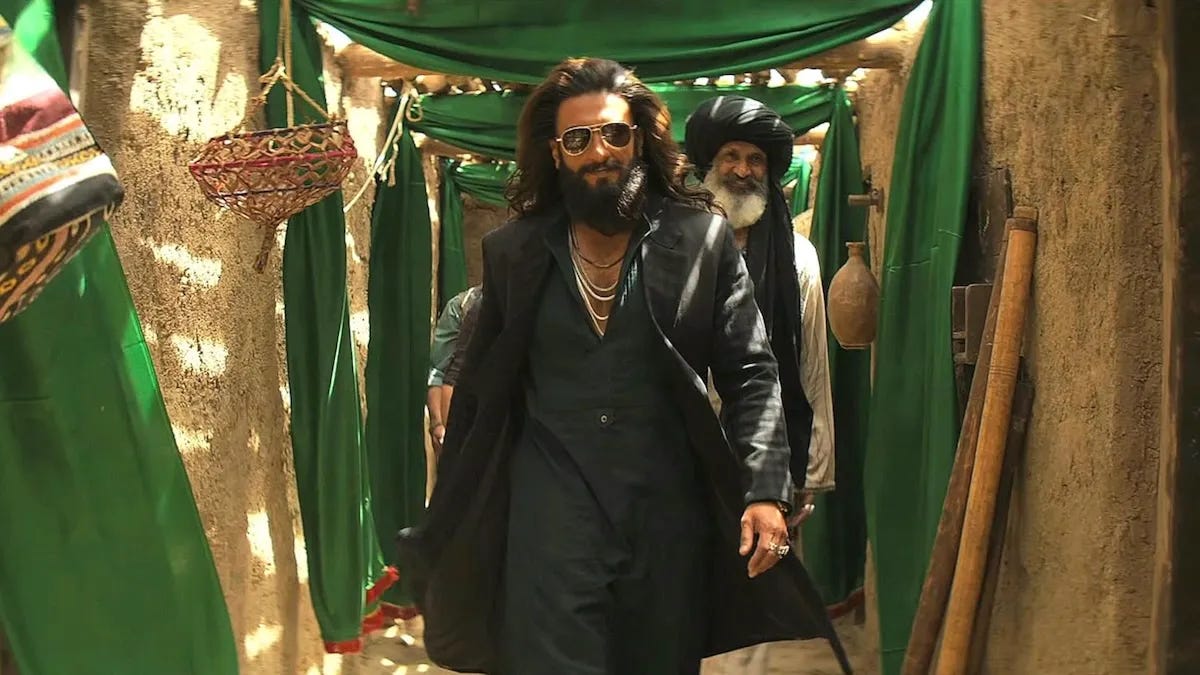
I’ve been obsessing over a Bollywood action film for weeks now. Not just because it’s extraordinary cinema, which is rare these days, but because it is one of those films that just stays with you, and has more layers than a piece of sticky pistachio baklava.
The film is Dhurandhar, a 2025 Indian spy thriller directed by Aditya Dhar, starring Ranveer Singh. Its sequel, Dhurandhar: The Revenge, came out in 2026. I watched both, back to back, and I haven’t been the same since. Over the past few weeks, my mind has become a secret shrine to this story, its motifs, and these unforgettable characters.
On the surface it is a lot of things.
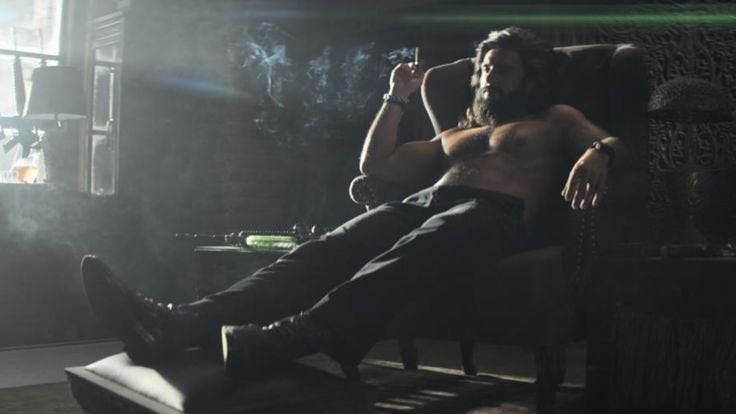
Very John Wick-esque. Fresh action sequences. Too much gore. Gangsters smoking non-stop. Luscious hair. Auramaxxing. Dripping in swag. A goated soundtrack. Cinema at its most visceral and kinetic. But underneath all of that, underneath the explosions and underworld politics and spy craft, this film is superloaded with dharma.
A Brief Map of the Story
Dhurandhar follows Jaskirat Singh Rangi, a RAW (Indian intelligence) operative who is sent deep undercover into Karachi, Pakistan, to infiltrate and dismantle an extremist terror network from within. He becomes Hamza Ali Mazari.
Over a decade of deep cover, Hamza rises through Karachi’s criminal underworld, forms alliances, builds a life, and slowly, cell by cell, begins to lose the man he once was.
The film's central tension isn't geopolitical. It's existential: who are you when you've worn another person's face for so long you can no longer find your own?
Now. The five things.
*There are some spoilers ahead, but I really don’t know how much of my readers watch Indian film, so either way, I know these things are worth sharing.
1. VIGILANCE AND PATIENCE ARE THE MOST LETHAL WEAPONS
Early in the film, Jaskirat’s handler Sanyal delivers what becomes the arc words of the entire story:
“Our most lethal weapons are vigilance and patience. Your goal isn’t to slip into Pakistan. Your goal is to dominate the whole jungle.”
In Hindi: नज़र और सब्र. Nazar aur sabr. Vigilance and patience.
Vigilance in this context is not paranoia. It is radical presence and awareness. The ability to read every room without showing that you’re reading it. Information flows in; nothing flows out. You notice everything and react to almost nothing.
Patience is not waiting. It is the willingness to play the long game even when every nerve in your body wants to act. The discipline to not be the loudest thing in the room. To let the jungle reveal itself to you, rather than forcing it to comply.
The dharmic lesson underneath this: reactive people rarely win anything that matters. The person who charges into the jungle makes noise. The person who learns the jungle becomes part of it, and eventually, the jungle answers to them.
Creating in this world requires the exact same thing. I keep thinking that pushing and white-knuckling will get me where I want to go. It won't. It's a fool's game. When we have a goal, we must truly keep our vigilance and patience razor sharp at all times. While everyone storms into the jungle, can you be the lion waiting for the perfect moment to strike? The first film run time is 3 hours and 25 minutes, and most of that runtime Hamza takes a backseat, allowing the villains and other characters to fill the screen, and he’s just there quietly waiting for his moment. Our culture and the landscape of social media tells us we're the main character at all times. But the most dangerous person in the room is often the one who doesn't need anyone to know it.
There’s a concept called The Lion Theory that I once heard about from Naval Ravikant and it’s simple, live like a lion. Spend most of your time resting and conserving your energy, and when you need to hunt, you explode in the opportune moment of attack.
It sounds simple. But most of us don't live this way. I’ve spent so much life gassing myself out, accomplishing, and so many of us are addicted to being chronically busy and showing people and telling people how busy we are, but what if we rested and leaned back, and waited with vigilance and patience for the right moment instead of trying to make every moment the right one? Life would feel quite different. Free.
2. SACRIFICE IS THE HIGHEST DUTY
The film carries a Sanskrit principle at its heart: बलिदान परमो धर्म.
Balidan paramo dharma. Sacrifice is the highest duty.
What the film does beautifully is show us that the most profound sacrifice is not the dramatic one. It’s not the single heroic moment. It’s the daily, invisible surrender of who you are, your name, your family, your history, your ability to be known by the people who love you, in service of a mission no one will ever publicly acknowledge.
Whether they die in a dark alley or come back as heroes, the duty itself is the reward. The mission justifies itself.
For those of us building something creative, something that isn’t guaranteed to work, the real sacrifice is subtle and private. It’s the Saturday you didn’t go out because you were editing, the version of yourself you left behind because you chose the true thing, the relationships that quietly strained under the weight of a dream other people couldn’t yet see. Nobody gives you a parade for that. The work asked it of you and you gave it.
This is an ancient idea that shows up in every wisdom tradition. The hand that gives without needing to be seen giving. The love that protects without needing to be thanked.
I ask myself this constantly. Especially on the days when nothing is performing, nothing is growing, and I have to choose whether to keep going anyway.
What are you still doing in service of recognition?
And what would shift if the act itself became enough?
3. THE EMPTINESS IN A CUP OF CHAI
One of my favorite scenes in the film is one that no one has talked about. It seems small, almost insignificant, but to me it’s everything.
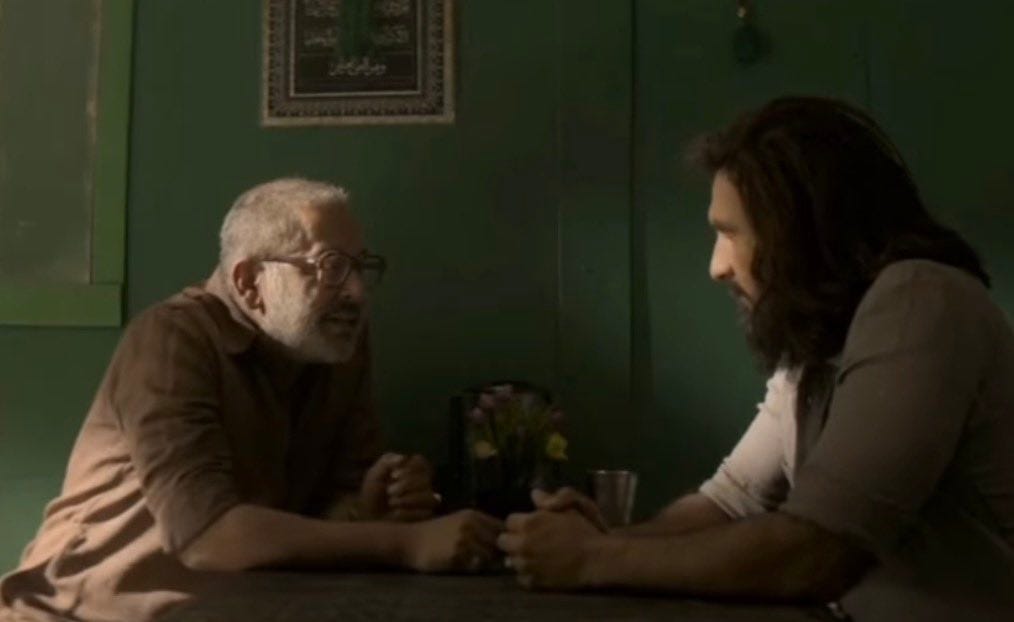
Hamza and his undercover ally Aalam, who poses as a juice shop owner, meet regularly at a chai vendor to trade intel. The first time they go, Aalam tells Hamza that the chaiwala puts salt in his chai. Most people hate it. But it reminds Aalam of home, because in his village the water was salty. This cup of chai is a piece of home for him. Hamza takes a sip and immediately spits it out.
Later in the film, Hamza is backed into a corner and has to take Aalam’s life to protect his cover. The next scene has no dialogue. You just watch him return to that chai shop alone, ordering two cups. One for his fallen friend. One for himself.
The chai didn’t get sweeter. It’s the same chai. But what it means to him has changed completely.
What Aalam is drinking is noon chai, also called pink chai or sheer chai. A Kashmiri tea made with gunpowder green tea, milk, and baking soda, brewed with water so naturally mineral-rich that it tastes of salt. To most people it’s an acquired taste at best. But that salt is the fingerprint of a specific place. It is the taste of home when home is thousands of miles away and you are living under a name that isn’t yours.
This is the Buddhist concept of shunyata, emptiness. Things have no inherent meaning. They are empty of a fixed nature. We are the ones who pour the meaning in. Aalam gave that salty chai its significance because it carried his homesickness, his history, his longing. Most people tasted something unpleasant. He tasted his village. The meaning is coming from us, not from the thing itself. It’s a projection of our heart.
It works the same way with everything we love. A song that breaks you open means nothing to someone else. Cilantro that my mom would mash with a mortar and pestle into my rice as a kid, turning it green, is the taste of being held. Some people think it tastes like soap. Neither of us is wrong.
This matters for your creative work too. Not as a reason to become neutral or to erase meaning, but as a reminder that the significance you feel in what you make is yours. You poured it in. Not everyone will taste it. And that’s not failure. Our job is simply to share it, and to the best of our ability, share why it matters. So that the people who resonate will pull up a chair and sip that salty chai right alongside you.
4. VULNERABILITY IS NOT A WEAKNESS
Ranveer’s performance as Hamza dismantled me quietly, the way a good film does, not with spectacle but with stillness, the way grief arrives not as a wave but as a slow filling of the lungs.
He built his entire career on bigness, the costuming, the noise, the physical maximalism of his presence. Here, he strips all of that away. And because we know what he’s capable of, the restraint becomes the performance. The absence of his usual armor IS the art.
What undoes me is this: Hamza is vulnerable with exactly one person in the entire film. Yalina, daughter of a corrupt politician he ends up falling in love with.
She is the one crack in the armor. The one place where the man beneath the operative bleeds through. And it is precisely because she is the only witness to that vulnerability that the stakes of losing her are so devastating.
The film reminds us, emotion is a liability in a mission. Attachment is a vulnerability to be weaponized by adversaries. And yet. Without Yalina, without that one place where he is seen, Hamza is nothing but a mission. He is not a person. He is a function.
Here’s what I keep thinking about. In the story, his vulnerability would get him killed. It is a tactical liability. His handlers would call it a weakness. His enemies would call it an opening. But for us, watching from the outside, his vulnerability is the only reason we root for him. It’s the only proof that a person still lives inside the operative.
And this is true for anyone creating anything publicly. Your openness won’t always be safe. People will misread it, project onto it, occasionally use it against you. But it is the only thing that transforms an audience into a community. Consumers into people who are genuinely pulling for you. Nobody roots for a function. They root for a human being. And a human being is only visible through the cracks.
5. BECOME NO ONE
At the very end of the film, and I’m giving you a spoiler here so hold gently, Hamza/Jaskirat returns to his village.
He doesn’t go inside. He stands outside his mother’s home and watches from afar as she and his sister go about their ordinary evening. Cleaning. Moving through the familiar rhythms of a life he once belonged to.
And he is overcome.
Not with grief exactly. With something harder to name. The realization that he is not Hamza anymore. But he is not Jaskirat anymore either. He is no one.
I felt an ache in my stomach watching this scene that I still haven’t fully digested.
My meditation teacher, Hector Marcel, said something at a retreat over a year ago that has stayed with me. He said: Become no one. That is the goal.
I think about that line differently now.
Because what Dhurandhar shows us is that there are two ways to arrive at no one.
The first is through loss, the way Jaskirat arrives. It is taken from you, stripped layer by layer through years of sacrifice, love, violence, betrayal. You don’t choose the emptiness. It chooses you. And that version of no one is a wound. It looks like devastation from the outside. It feels like annihilation from within.
The second is through liberation, the way the mystics speak of it. The self is released, not destroyed. The dissolution is chosen. The emptiness that remains is not a void but a spaciousness. Room for something real to move through.
I think about this every time I sit down to make something and feel the pull to be someone specific, someone legible, someone safe. The ego wants a name, a lane, a brand. The soul just wants to move through you cleanly.
What is extraordinary about that final scene is that the film holds both of these simultaneously. You cannot tell if what you are watching is the most broken moment of this man’s life, or the moment he is, paradoxically, the most free.
That ambiguity is the film’s greatest gift.
The person who is truly no one is no longer protecting anything. Defending anything. That nakedness, that complete unarmored presence, is exactly what Hector means.
The ache you feel watching it, if you feel it, is your nervous system recognizing something true about the spiritual path that is rarely spoken aloud. That becoming no one passes through something that looks and feels indistinguishable from devastation.
The film ends with a flashback training montage. Hamza is at the bottom of a pool, weighted down, holding his breath while his comrades panic and tap out around him. He is not struggling. He is still. Almost blissful. And the voice of his mentor underneath it all:
“The more control you have over your breath, the slower you burn it, the tighter your control over stress and emotion. You go full throttle only when life is on the brink.”
Sit in the emptiness. Don’t flinch. Burn slowly.
And when life calls you to the surface, you will know.
He was always being trained to become no one.
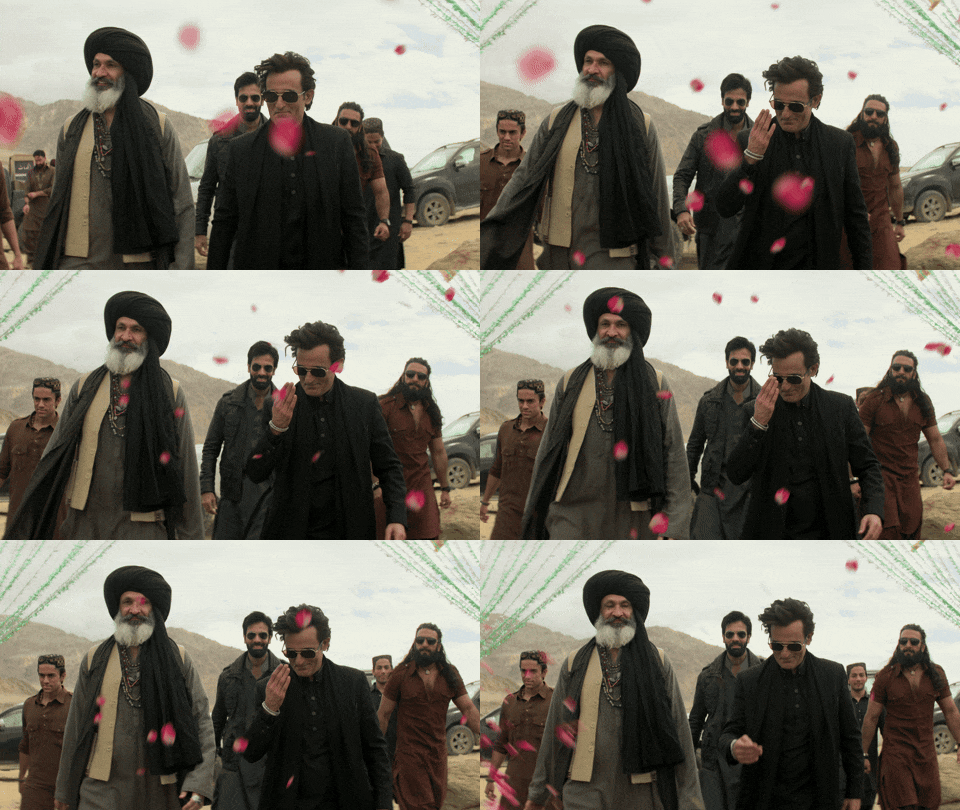
P.S. I'd be doing you a disservice if I didn't mention the soundtrack. Goated doesn't even cover it. Consider this your new lion era playlist.
Minutes meditated so far this year: 3,000 minutes 🧘🏽♀️
About Me
I’m Asa. I am a Bangladeshi-American meditation teacher, writer, and podcast host.
I believe vulnerability is the most powerful thing we have. Not as a tactic, but as the actual portal to building a life and a business that feels like yours. The more honest we are about who we are and what we struggle with, the more we give other people permission to do the same. That is the whole philosophy behind everything I create.
Born and raised in New York. Living in Charleston. I am a cinephile, a mango connoisseur, and a chai addict. So glad you are here — make yourself at home. 🤎


When you’re ready, here are three ways I can help:
1:1 Monsoon Mentorship: a private coaching container for creatives and founders ready to build a life and body of work rooted in clarity and vulnerability.
NEW The Brand Audit: a 90-minute strategic review of your personal brand, content, positioning, and online presence designed to uncover what’s working, what’s not, and where your greatest opportunities for growth and leverage exist.
NEW The Brand Intensive: a high-touch two-session strategy experience designed to clarify your message, refine your brand story, sharpen your positioning, and create a cohesive vision for the next chapter of your work.
Stay soft,
🥭 Asa
I think I’ll probably come back to this one again and again. These lessons/reminders are true gems! I’m at the beginning of a birthing a creative dream and that piece about vigilance and patience HIT. Much appreciated 🙌